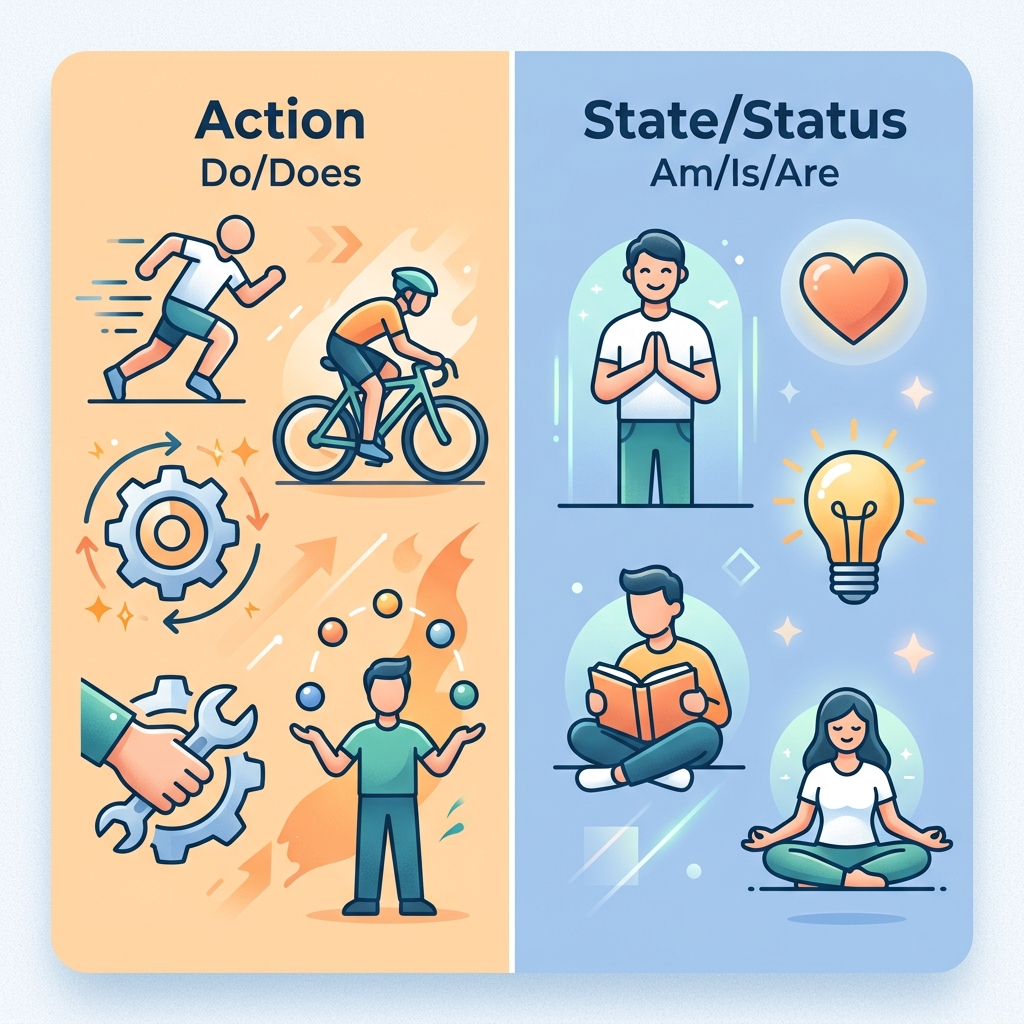
Why do English questions require Do / Does / Did and Am / Is / Are?
When practicing spoken English, the most common mistakes blurted out are “Do you happy?” or “Are you eat meat?”
Although native speakers can probably understand what you mean, their brains will experience a brief 0.5-second “something sounds off” moment of awkwardness.
Actually, to quickly tell which word to start with in daily conversation, you don’t need to memorize complex grammar rules — just master this “operating logic” and you’re good to go!
1. The Ultimate Formula: Is It an “Action” or a “State”?
In the English mindset, all questions are categorized based on whether you’re asking about an “action” or an “identity, state, or description”.
A. Use Do / Does / Did: For “Regular Verbs”
When what you want to ask about is an “action” (like: eat, run, like, work, know), use the Do family. Think of it as an “action catcher” that specifically pulls out the verb that follows.
- Do you exercise? (Do you work out? → “exercise” is an action)
- Do you know the answer? (Do you know the answer? → “know” is a mental action)
B. Use Am / Is / Are: For “States, Identities, and Adjectives”
When what you want to ask about is a “current identity, feeling, or state”, use Be verbs.
- Are you hungry? (Are you hungry? → “hungry” is an adjective state)
- Are you working? (Are you working? → “ongoing state of doing”)
- Are you a developer? (Are you a developer? → “identity”)
2. Intuitive Quick Conversion
If you’re chatting with a native speaker and your brain can’t react fast enough, use this “intuition method” to switch:
“Are you…?” / “Is it…?” $\rightarrow$ Use Are
Whenever your question implies a concept of “being” something, there’s a high chance English uses
Are.
- Are you serious? $\rightarrow$ Are you serious?
- Are you happy? $\rightarrow$ Are you happy?
- Are you on the MRT? $\rightarrow$ Are you on the MRT?
“Do you…do…?” / “Do you ‘verb’…?” $\rightarrow$ Use Do
Whenever your question emphasizes an “action”, or even a habitual behavior, you need
Doto help out.
- Do you drink coffee? $\rightarrow$ Do you drink coffee?
- Do you like traveling? $\rightarrow$ Do you like traveling?
- Do you use this software? $\rightarrow$ Do you use this software?
3. Advanced Intuition: Why Are “Are you free?” and “Do you have time?” Both Asking About Availability?
Now that you’ve learned the formula, let’s look at this common workplace example. These two sentences mean exactly the same thing, so why do they start differently?
- “Are you free?”: Because Free is an adjective (a state of being available).
- “Do you have time?”: Because Have is a verb (the action of possessing time).
This is what makes English interesting: whatever characteristic the first keyword that pops into your head has determines which word you start with.
Conclusion: Understanding “Logic” Is More Important Than Memorizing “Rules”
English grammar isn’t meant to be memorized — it’s meant to help you understand how native speakers perceive the world through “actions” and “states.” Master this “keyword conversion method,” and next time you speak, you’ll be more confident in choosing the right auxiliary verb, making your conversations flow smoothly!